Biometric Attendance System and Geo-Attendance: How They Work and What Organisations Should Look For
From facial recognition to GPS tracking, discover how modern attendance management software helps businesses automate employee check-ins, reduce attendance errors, and manage field teams.
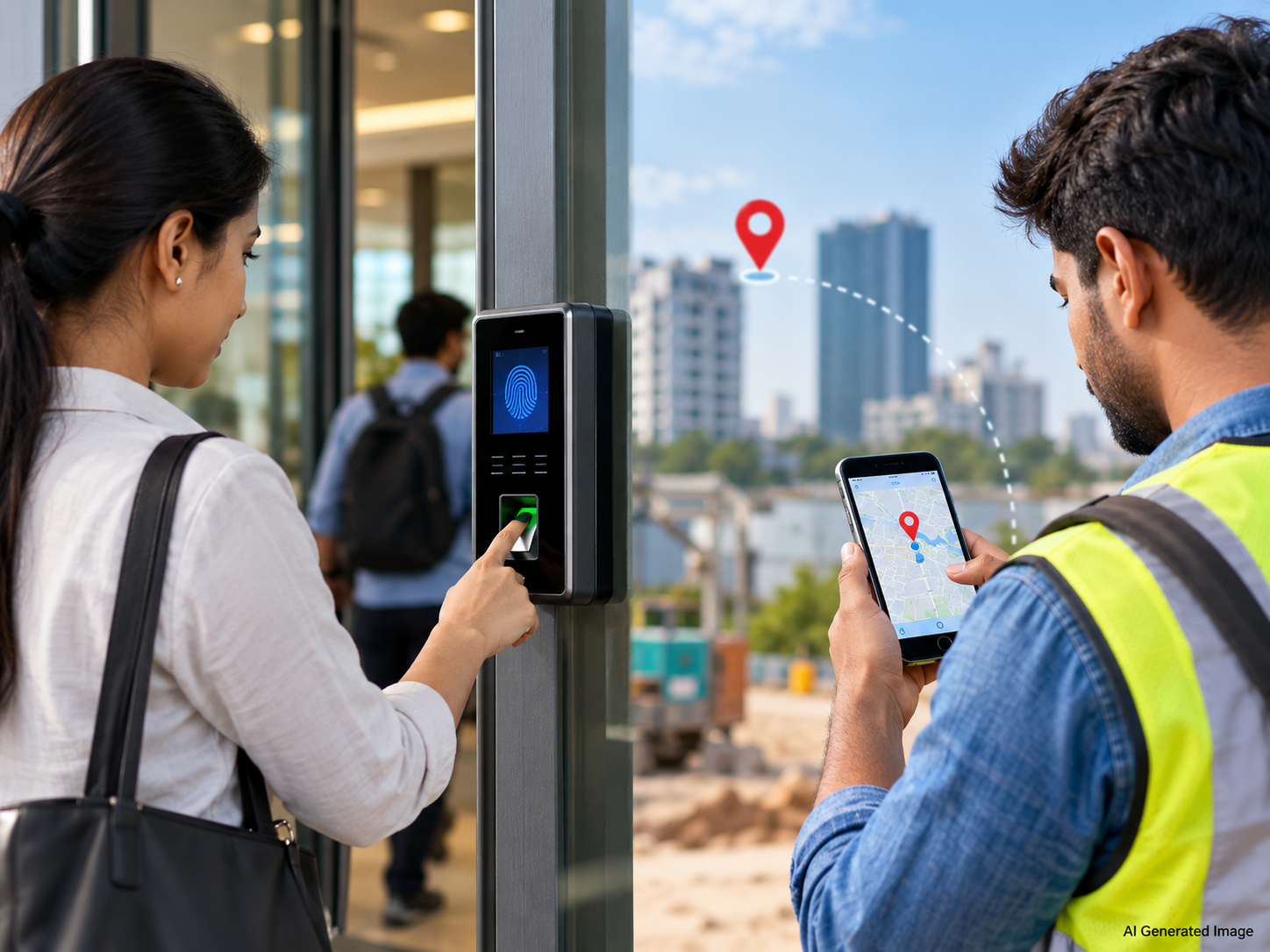
Attendance tracking has moved beyond paper registers and manual timesheets. Organisations can use biometric and geo-attendance software to record employee attendance, verify identities and monitor check-in locations.
Whether managing centralised corporate offices, remote industrial facilities, or on-the-ground sales representatives, choosing the right digital infrastructure guarantees operational continuity.
What Is a Biometric Attendance System?
A digital solution that uses unique physical characteristics, such as fingerprints, facial recognition, or iris scans, to verify employee identities and record work hours. It integrates with attendance management software to automate time tracking, reduce human error, and prevent buddy punching.
- Prevents Time Theft: Stops employees from clocking in for others.
- Streamlines Payroll: Automatically records working hours, overtime, and leave for payroll processing.
- Enhances Security: Uses biometric verification to help prevent unauthorised access to facilities.
- Improves Accuracy: Reduces manual data entry errors and eliminates paper-based timesheets.
How a Biometric Attendance System Works
It captures unique physical characteristics, converts them into digital templates, and compares them with pre-registered data to verify employee identities and record attendance.
Fingerprint and Iris Scanning
- Capture: Sensors scan fingerprint ridges or capture distinctive iris patterns.
- Feature Extraction: The system identifies key features, such as fingerprint ridge endings and iris patterns.
- Matching: The captured data is compared with stored biometric templates to verify identity.
Face Recognition Attendance System
- Facial Mapping: A camera maps facial geometry and measures distances between features, such as the eyes, nose, and jawline.
- Similarity Scoring: The system calculates how closely the captured face matches the stored template.
- Identity Verification: Access or attendance approval is granted when the score meets the configured confidence threshold.
Liveness Detection and Anti-Spoofing
- Spoofing Prevention: Advanced algorithms help detect attempts to use photographs, videos, or facial masks.
- Movement Analysis: The system may analyse blinking, eye movements, and skin texture to distinguish a live face from a presentation attack.
- Infrared Sensing: Some systems use infrared imaging to support liveness detection and distinguish real faces from photographs or screens.
What Is Geo-Attendance? How GPS and Geo-Fencing Work
A mobile-based attendance system that uses GPS (Global Positioning System) coordinates and location-tracking technology to verify employees’ physical presence at assigned work sites when clocking in or out.
GPS Location Verification at Punch-In
- Real-Time Coordinates: When an employee punches in through a GPS attendance system, the app records latitude, longitude, timestamps, and device details.
- Fraud Prevention: Helps prevent buddy punching and reduces manual sign-in errors.
- Point-in-Time Privacy: Records location at punch-in or punch-out rather than continuously, depending on system settings.
Geo-Fencing: Setting Virtual Boundaries per Site
- Virtual Perimeters: HR teams define boundaries around offices, client locations, or construction sites using a specified radius.
- Location Validation: Enterprise Geofencing app accepts punches within the designated boundary and blocks or flags entries made outside it.
- Multi-Site Flexibility: Employees can be assigned to multiple approved zones, including offices and rotating client worksites.
Mobile Attendance App for Field Employees
- Offline Punching: Field employees can record attendance in remote areas or locations with poor connectivity, where offline functionality is supported.
- Local Storage: The app stores timestamps and GPS coordinates on the device until connectivity is restored.
- Automatic Cloud Sync: Attendance records upload to the central HRMS or payroll database via Geo-Tagged Field Capture once an internet connection becomes available.
Biometric vs Geo-Attendance: Which Fits Your Organisation?
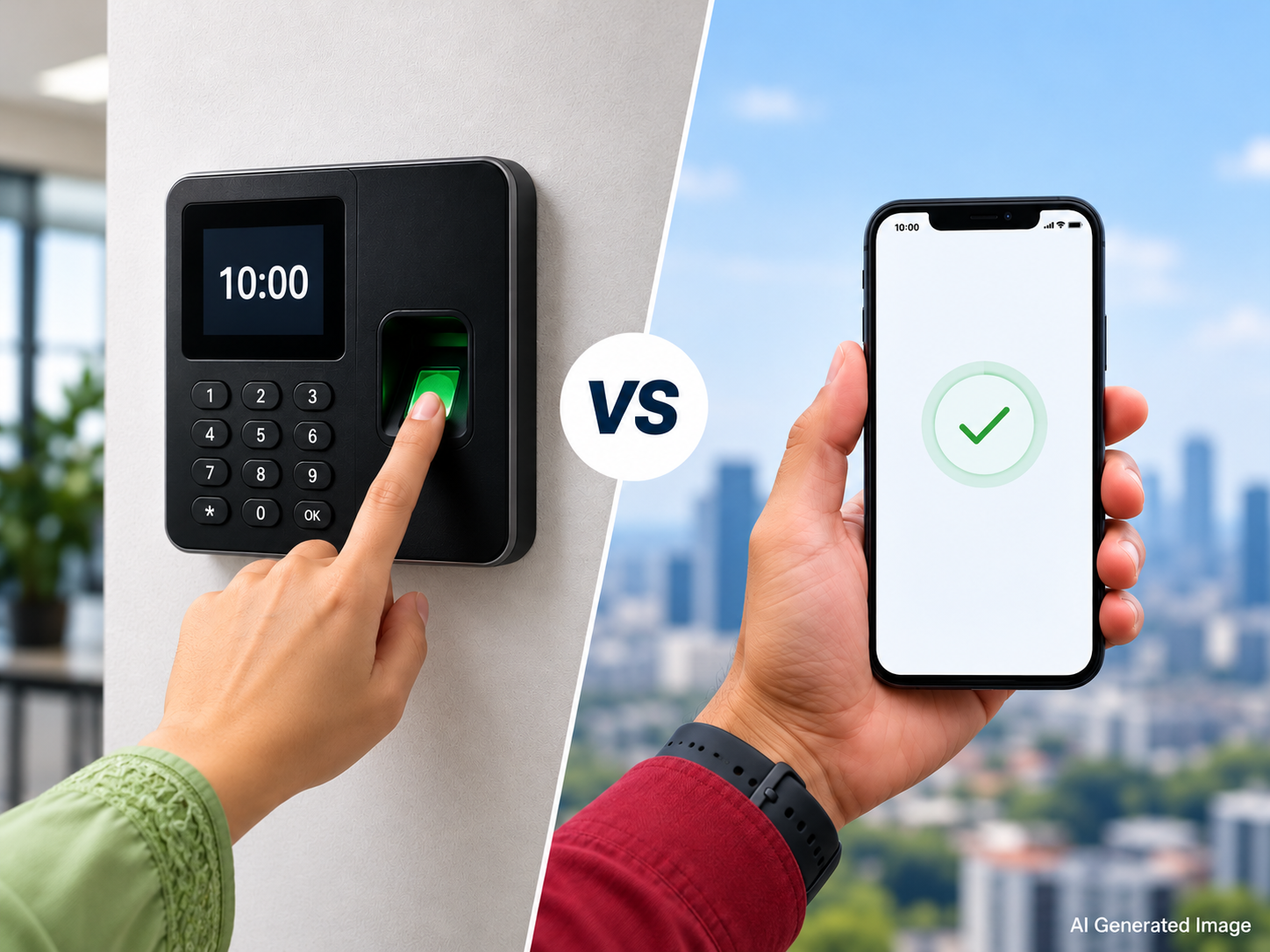
Choosing the right employee time tracking method depends on your workforce structure, budget, and operational requirements.
| Feature | Biometric Attendance | Geo-Attendance |
| Workforce Suitability | Office-based and on-site teams | Field-based and remote teams |
| Hybrid Flexibility | Limited to physical checkpoints | Supports attendance across approved locations |
| Hardware Requirements | Dedicated biometric devices or scanners | Uses existing employee smartphones |
| Fraud Prevention | Helps prevent proxy attendance through biometric verification | Uses GPS verification and anti-spoofing measures to reduce fraudulent check-ins |
| Cost Structure | Higher upfront costs for hardware and installation | Typically lower upfront costs with subscription-based software |
Why Combining Both Helps Prevent Proxy Attendance
Combining biometric verification with geo-attendance solutions adds two layers of security to help prevent proxy attendance and buddy punching. By verifying employee identity and location, organisations can confirm that the correct employee is checking in from an authorised work site.
- Facial Recognition and GPS Validation: During clock-in, the mobile app can capture a facial scan and verify the employee’s location using GPS coordinates.
- Stronger Fraud Prevention: Geo-fencing helps flag check-ins outside approved locations, while facial recognition helps prevent colleagues from recording attendance on someone else’s behalf.
What Organisations Should Look For: A Buyer’s Checklist
Organisations selecting an attendance platform must evaluate technical capabilities, system integration, data security, and total cost of ownership to ensure operational efficiency.
Accuracy, Anti-Spoofing and Liveness Checks
The system must feature high-precision matching engines alongside active liveness detection. This helps the platform distinguish a live person from a spoofing attempt and block fraudulent punch-ins using printed photos, high-definition digital videos, or deepfake 3D masks.
Offline Mode and Low-Network Performance
Reliable applications require robust local device storage to handle remote sites and network disruptions. The software must securely cache encrypted timestamps and GPS coordinates on the smartphone or hardware unit, then automatically sync all logs to the cloud once internet connectivity returns.
Attendance and Payroll Integration
Seamless API compatibility is essential for connecting time tracking with payroll processing. The system should automatically transfer real-time attendance data to existing payroll and HRMS software through secure API and system integration, reducing manual spreadsheet uploads, data entry errors, and administrative delays.
Cloud-Based Attendance Software vs On-Premise
Assess your infrastructure preferences before purchasing. Cloud-hosted solutions offer rapid deployment, automatic updates, and remote access through a subscription model. Conversely, custom on-premises deployments supported by mobile app development may require dedicated internal servers while offering greater control over sensitive data environments.
Data Privacy and Consent for Biometric Data
Implementing a compliance framework helps protect the enterprise from legal liabilities. Look for platforms offering end-to-end data encryption, automated data-purging policies, and integrated digital consent forms to ensure data storage practices align with local privacy laws and international regulations.
Scalability, Reports and Admin Controls
The system must accommodate organisational growth without performance degradation. Administrators need centralised management dashboards, automated real-time anomaly alerts, customisable geo-boundaries, and detailed reporting tools to track workforce metrics across departments, projects, and geographic regions.
Pricing, Add-on Costs and Support
Evaluate the total cost of ownership by reviewing vendor pricing for hidden fees. Ensure the per-user subscription or fixed hardware cost explicitly covers technical configuration, ongoing maintenance, firmware updates, and reliable customer support to avoid unexpected operational constraints.
Choosing GPS / Biometric Attendance Software in Kolkata
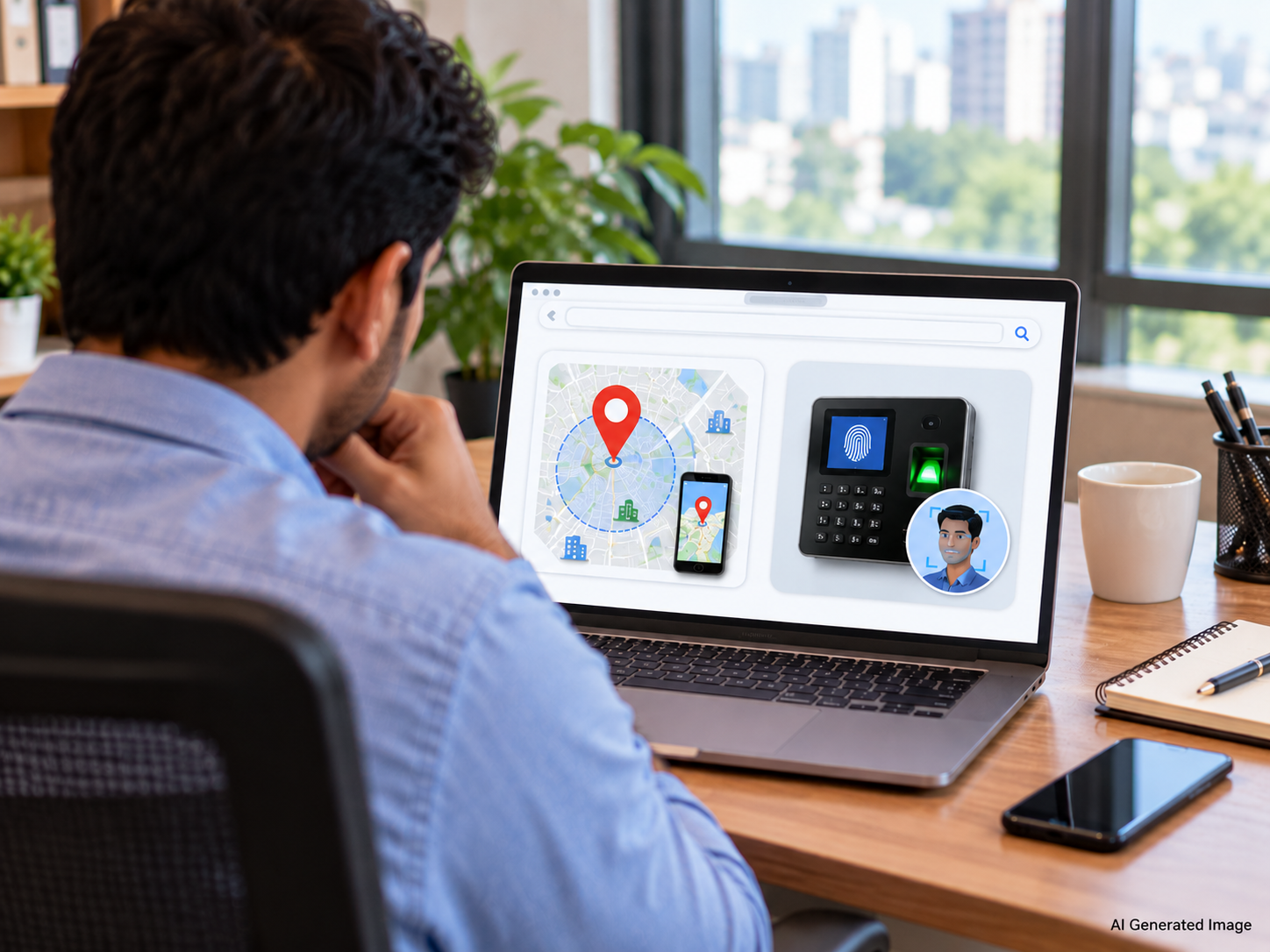
Selecting the right workforce system requires balancing custom and off-the-shelf software with on-site training, technical support, and seamless integration with existing HR or ERP platforms.
For a local solution, explore the EBLUESYS Biometric & Geo-Attendance project, which combines facial recognition with GPS location verification to help prevent proxy attendance and reduce payroll processing time.
Ready to upgrade your employee tracking? Request a demo today!
How to Roll Out an Attendance System Without Employee Pushback
Deploying an attendance platform smoothly requires proactive change management to address employee concerns about privacy, tracking accuracy, and data security.
- Run a Pilot: Test the platform with a small department to identify software bugs and resolve usability issues before the full launch.
- Communicate Consent: Clearly explain data encryption, biometric data handling, and privacy safeguards, and obtain documented employee consent where required.
- Test Geo-Fences: Adjust virtual boundaries during pre-launch trials to minimise false punch-in rejections caused by GPS inaccuracies.
- Execute Parallel Runs: Run the software alongside legacy timesheets for one cycle, leveraging intelligent workflow automation to flag, approve, and resolve complex attendance exceptions efficiently.
The Verdict
Upgrading to an integrated attendance system reduces payroll fraud, streamlines compliance, and improves workforce accountability. Stop losing revenue to manual errors and proxy attendance.
Ready to transform your operations and strengthen workforce management in Kolkata with GPS / biometric attendance software?
Connect today and get started!
Frequently Asked Questions
How does a biometric attendance system work?
Optical or digital sensors scan unique physiological traits and convert them into secure mathematical templates. The platform compares live inputs against registered database records to instantly verify identity and log timestamps.
What is the difference between biometric and geo-attendance?
The first relies on physical characteristics, such as fingerprints or facial maps, at fixed terminals. The second uses mobile coordinates and virtual perimeter boundaries to track mobile or remote workforces.
Can employees fake GPS or face attendance?
No. Advanced platforms deploy active liveness detection to block printed photos or video spoofing attempts, while cryptographic location verification identifies and rejects virtual coordinates from mock location software.
Is biometric attendance data safe and legal in India?
Yes. Compliance is achieved by encrypting stored templates under the Digital Personal Data Protection (DPDP) Act. Organisations must obtain explicit consent and implement strict corporate data governance policies.
How much does GPS or biometric attendance software cost in Kolkata?
Costs depend on the software, number of users, hardware requirements, and deployment model. Cloud subscriptions may charge per user monthly, while biometric terminals involve upfront device and installation costs. Request a vendor quotation for accurate pricing.
Disclaimer:
This article is for informational purposes only and does not constitute formal legal or financial advice regarding workforce compliance. Organisations must independently verify applicable labour laws and data privacy regulations before deploying an attendance tracking system.